
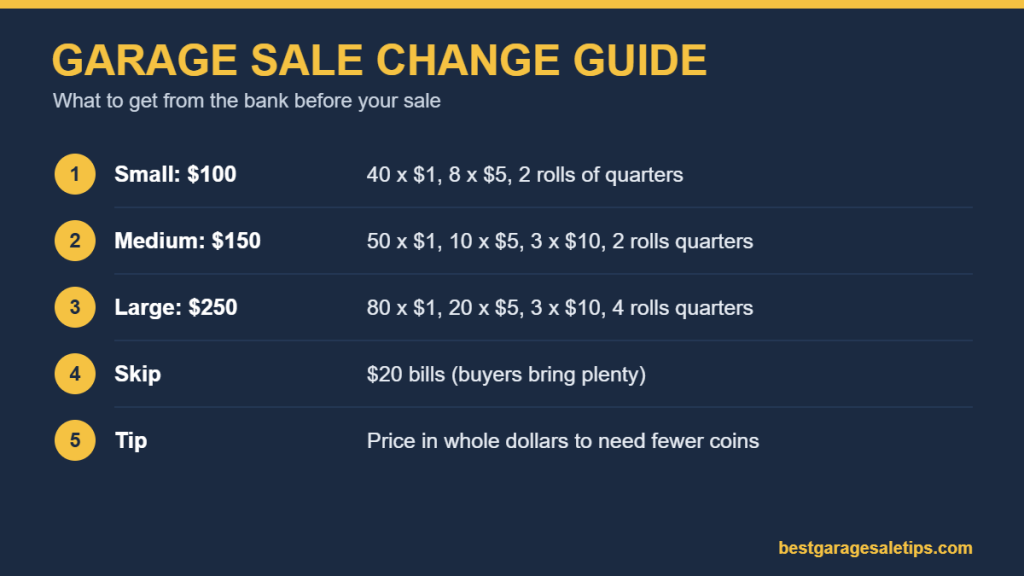
For most garage sales, have $100 to $150 in change: mostly $1 bills and $5 bills, plus two rolls of quarters. For a big multi-family sale, bring $200 to $250. Skip $20 bills in your float. Buyers bring plenty of their own because ATMs hand out $20s, and you’ll need small bills to break them.
| Sale size | Total change | What to get from the bank |
|---|---|---|
| Small (one family, a few tables) | $100 | 40 x $1, 8 x $5, 2 rolls of quarters |
| Medium (full garage or driveway) | $150 | 50 x $1, 10 x $5, 3 x $10, 2 rolls of quarters |
| Large (multi-family or moving sale) | $250 | 80 x $1, 20 x $5, 3 x $10, 4 rolls of quarters |
A roll of quarters is 40 quarters, or $10. If none of your prices end in 25 or 75 cents, you can skip quarters and keep a few extra $1 bills instead.
Why you need so many small bills
Early-morning shoppers often stop at an ATM on the way, and ATMs mostly dispense $20s. If your first five buyers each hand you a $20 for a $2 item, that’s $90 in change gone in the first half hour. Ones and fives are what run out first, so get more of them than you think you’ll need.
How to price so making change is easy
- Price in whole dollars or 50-cent steps. Fewer coins means a faster line. Our garage sale pricing guide shows what to charge for common items.
- Use bundles. “3 for $1” or “fill a bag for $5” keeps the math simple.
- Round up totals. If someone buys a $1.50 item and a $2 item, offer it for $3. Most buyers love it, and you skip the coins.
Where to get change
Go to your bank a day or two before the sale and ask a teller for small bills and rolled coins. Some banks only give rolled coins to account holders, so use your own bank. Don’t wait until the morning of the sale, because many branches open after garage sale shoppers are already out.
Take payment apps to need less cash
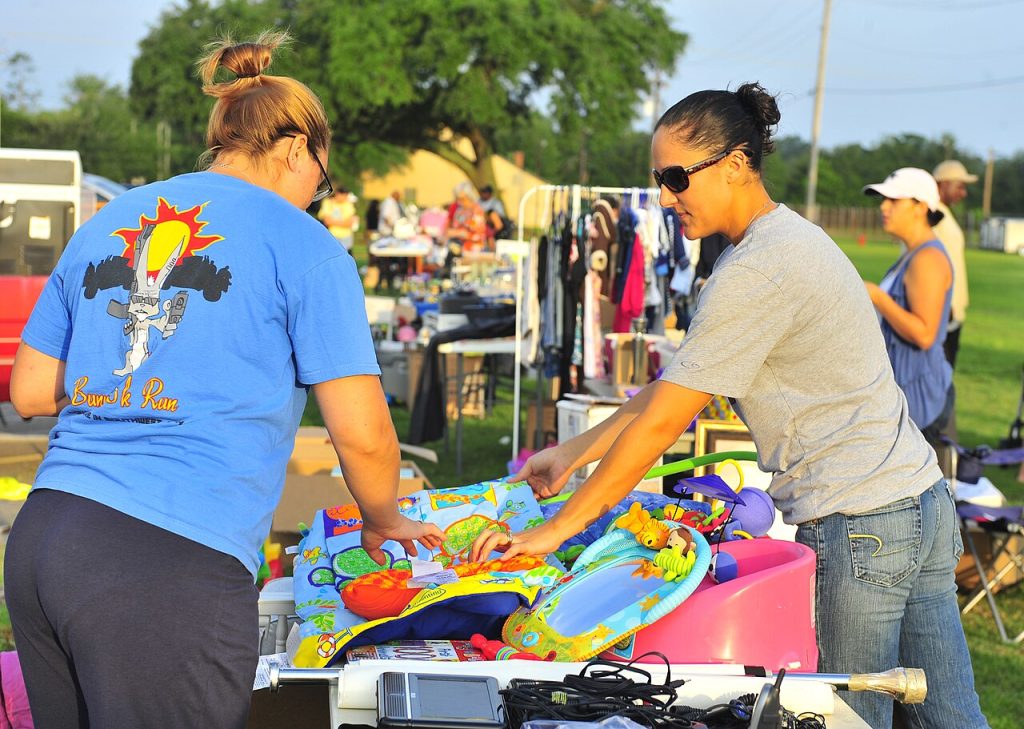
A sign that says you accept Venmo or Zelle means fewer buyers need change at all, and you won’t lose sales to shoppers who have no cash. Here’s how to accept Venmo, Zelle and cards at a garage sale safely.
How to keep your cash safe
- Keep it on you. A fanny pack or apron with pockets is safer than a cash box on the table.
- Move big bills out. Once you collect a few $20s, take them inside or put them in a separate pocket.
- Count your float. Write down how much you started with so you know exactly what you made.
- Check large bills. A counterfeit detector pen costs a few dollars and is worth it if you’re selling furniture or other big-ticket items.
- Have two people. One person can handle money while another answers questions and watches the tables.
Getting ready for your sale? Use our garage sale checklist so nothing gets missed.
Related: garage sale safety tips.
FAQ
Should I take $20 bills at a garage sale?
Yes, just make sure you have enough small bills to make change. That’s why your starting change should be mostly $1s and $5s.
Do I need coins at all?
Only if you price items at 25 or 50 cents. Many sellers price everything in whole dollars and skip coins entirely.
What if I run out of change?
Ask the buyer for exact change, offer a small discount to round the total, or take payment by app. A neighbor or a nearby store may be able to break a large bill too.